- Last Update 2026-04-02 15:09:00


The Numbers Game in the Geopolitics of Destruction

Prof Janek Ratnatunga
Geopolitics provides a framework for understanding the complex international relations shaped by geographical factors, especially as the global rules-based order becomes increasingly fractured. In this volatile landscape, geopolitical strategies often revolve around control over geographical entities—regions, territories, and networks—that provide political advantages.
Geopolitics, at first glance, appears to be a world removed from the’ numbers world’ of Accountants, especially management accountants. However, the latter, who typically focus on strategic decision-making, cost management, resource allocation, and supply-chain logistics, can have a new and profound relevance in the field of geopolitics.
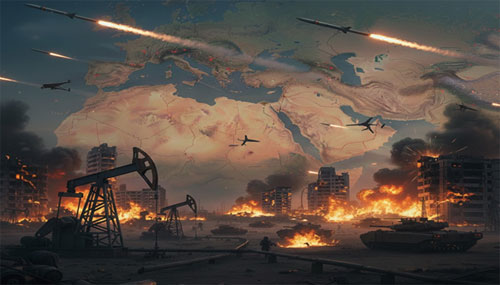
Geopolitical Dynamics in the Middle East
The ongoing conflict involving the United States, Israel, and Iran exemplifies the complex interplay between geopolitical objectives and management accounting. This conflict, now in its ninth day, highlights the significant financial strain that Iran's low-cost drones impose on the U.S. and its allies. These drones, while inexpensive to produce, require costly missiles to neutralize, turning the conflict into a massive economic burden for the U.S. This scenario underscores the need for modern military forces to incorporate management accounting principles in strategic planning, particularly in areas like distributed production, supply-chain logistics, target costing, and pricing.
Cost-Benefit Analysis of Air Dominance
From the outset, the U.S. has dominated the skies above Iran, but the economic realities are not in America's favour. Iran effectively uses low-cost drones for precision attacks, challenging the U.S.'s sophisticated yet expensive air defence systems. Clearly, there is an economic imbalance, where it is significantly cheaper to deploy drones than to intercept them. Iran has launched over 2,000 drones, many of which have reached their targets despite billion-dollar defence systems, posing a sustainability challenge for defence economics.
Effectiveness and Cost of Iranian Drones
Iranian Shahed drones, designed with off-the-shelf commercial electronics, have proven highly effective. Costing between $20,000 to $50,000, these drones are affordable yet potent, capable of long-range attacks across the Middle East. In contrast, the U.S. relies on expensive interceptors like the Patriot air defence system, costing over $3 million per shot. This disparity highlights the need for more cost-effective counter-drone technologies.
The U.S. military, traditionally focused on high-end unmanned systems, has struggled to produce low-cost, expendable drones. The U.S. has recently attempted to reverse-engineer Iranian drones. However, the deployment of these tweaked versions is still months from fruition, highlighting a gap in rapid response capabilities.
Iran’s ‘Rope-a-Dope’ Strategy
Iran's strategy mirrors the ‘rope-a-dope’ boxing technique introduced by Mohmmed Ali in the Rumble-in-the Jungle, where it absorbs heavy attacks from adversaries before launching cost-effective counterattacks with drones. This approach aims to exhaust opponents economically while retaining the capability to retaliate. Reports suggest that Iran is now escalating its counterpunching efforts, deploying more sophisticated missiles with precision targeting. This tactic raises questions about the sustainability of U.S. and allied resources, as speculation grows about potential shortages in interceptors.
Iran’s ‘Dead Hand’ System of Command and Control
Iran's decentralised command-and-control system, reminiscent of the Cold War-era ‘Dead Hand’ mechanism, ensures retaliation even under severe attack where the top command is wiped out in a nuclear attack. This system, originally designed to guarantee Mutually Assured Destruction (MAD), has enabled Iran to maintain strategic parity with more powerful adversaries even when its top command and even its second and probably third tier leaders were wiped out on first strike of the conflict. This forward planning reflects Iran's preparedness to leverage its drone and missile capabilities in the entire region, further complicating the military and economic calculus for its opponents.
Lessons from History
There are historical parallels with World War II, emphasizing the need for rapid military build-up in contemporary conflicts. Unlike the extensive timelines in past wars, modern conflicts demand swift responses, underscoring the importance of foresight in military resource management.
When World War II broke out in Europe in 1939, Germany had 2400 tanks. In that year the US had let its military stocks run down to the extent that its army’s strength was measured 39th in the world. The US did not enter the war until it was attacked by Japan at Pearl Harbour on December 7, 1941. The US entry to the war sparked the biggest and fastest military build-up in world history, with President Roosevelt setting astounding goals. By the end of the war in 1945, four years later, America had produced two-thirds of all military equipment used by the allied nations: 297,000 aircraft, 193,000 artillery pieces, 86,000 tanks and 2 million army trucks.
The point is that in a conventional 20th Century war, one can count in months and years the ramping up of military hardware. However, today’s 21st Century war required a response in days. This means that the US and Israel should have been building up a significant stockpile of interceptors and drones before their pre-emptive strike. It does not appear that such planning was undertaken.
Convergence of Drones and Affordable Cruise Missiles
The evolution of warfare is further marked by the advent of affordable cruise missiles. These weapons, driven by advancements in technology and production, offer a new class of low-cost missiles termed ‘affordable mass.’ This development allows for mass production and deployment of missiles at a fraction of traditional costs, highlighting a shift in strategic military planning.
The convergence of drone and cruise missile technologies signifies a transformative shift in military capabilities. Modular designs, aided by cheaper electronics and 3D printing, facilitate rapid modifications for specific missions. This trend blurs the lines between traditional missiles and drones, enabling countries to produce versatile, cost-effective weapons systems.
Distributed Production and Strategic Implications for Global Powers
The shift towards distributed production allows military alliances like NATO to meet combat demands by duplicating production cells across member nations. This approach ensures rapid assembly and deployment of missile systems, adapting to the dynamic needs of the battlefield. By leveraging multiple suppliers and decentralized manufacturing, countries can build and assemble missile components quickly, enhancing their military readiness. However, again this should have been pre-planned before the attack.
In regions like the Middle East, the presence of affordable cruise missiles challenges traditional power dynamics. The United States and Israel face logistical challenges in acquiring similar weaponry swiftly, while Iran and other nations capitalize on these cost-effective technologies. This shift compels military strategists to collaborate closely with management accountants to effectively allocate resources and optimize production.
In Europe, Ukraine's reliance on NATO-supplied cruise missiles underscores the importance of international cooperation in addressing military needs. Despite expanding its own missile production capabilities, Ukraine remains dependent on U.S. interceptors, which are also in demand for conflicts like the one in Iran.
In the Pacific, countries such as China, North Korea, and Russia are investing heavily in missile technology, altering the strategic landscape. For Australia, historically buffered by geographical distance, the rise of affordable missile technology diminishes this natural advantage. This necessitates a re-evaluation of defence strategies and resource allocation to ensure national security.
In summary, the evolving nature of warfare, characterized by the integration of low-cost drones and cruise missiles, demands a recalibration of military and economic strategies. By embracing management accounting principles, military forces can better navigate the complexities of modern conflicts. Strategic decision-making, cost management, and efficient resource allocation are essential to maintaining military effectiveness in a rapidly changing geopolitical environment.
Professor Janek Ratnatunga, is currently CEO of the Institute of Certified Management Accountants of Australia & New Zealand (CMA ANZ).

-
Still No Comments Posted.





- March 26, 2026 - 436 - 0
50 more Forests declared under Wanaspati programme
The Ministry of Environment has taken steps to declare an additional 50 forests as protected reserves, Under the ’Wanaspati’ National Programme.


- March 25, 2026 - 203 - 0
Former SIS chief Sallay hospitalised
The former Head of the State Intelligence Service, Major General (Retired) Suresh Sallay has been admitted to the Colombo National Hospital after his medical condition was notified to the Magistrate.
Related Articles

Water cuts commence from today in Colombo district
- 02/04/2026 - 32 - 0

Govt. introduces special fuel app for tourists
- 02/04/2026 - 40 - 0

Top stories of the day
- 01/04/2026 - 97 - 0

Top stories of the day
- 31/03/2026 - 98 - 0
Leave Comments