- Last Update 2026-04-26 09:25:00


The secret dance that guides bees: Decoding Sri Lanka’s floral language
By Wikum H Jayasinghe
In the lush, tropical landscapes of Sri Lanka, a silent but complex conversation is happening every day within the hives of the honey bee species. In the busy world of a beehive, communication does not happen through sound or words, but through dance. Scientists have long discovered that honeybees use a remarkable method known as the “waggle dance” to share precise instructions about food sources with their colony members. In the lush, tropical landscapes of Sri Lanka, this dance reveals a fascinating story of how three different bee species coexist, compete, and find their way in a world of constant bloom.
How do you ask a bee where you have been?
When a worker bee finds a patch of flowers rich in nectar or pollen, it returns to its home and performs an energetic movement in a figure-eight pattern. This is not just a simple wiggle; it carries a sophisticated code. The direction of the dance tells other bees which way to fly using the sun as a guide, while the intensity of the performance suggests the richness of the food source. Interestingly, the length or tempo of the "waggle" indicates the distance: a fast tempo means the food is nearby, while a slower dance signals a greater distance.
Meet the Three Sisters
Sri Lanka is home to three species that use this language, each with a unique lifestyle:
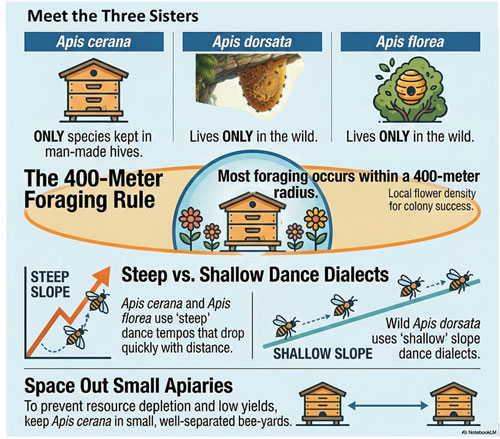
- Apis cerana (Honey bee): This medium-sized bee is the only species domesticated and kept in man-made hives for commercial honey. They build multiple parallel combs in protected spaces like hollow trees.
- Apis dorsata (Rock bee): A wild species that builds massive single combs on open rock cliffs or high branches. Famously found in Sigiriya rock.
- Apis florea (Dwarf bee): The smallest species, also living exclusively in its natural habitat, building tiny exposed nests where it performs its dance on the flat top of the comb.
The "Dialects" of Distance
Research shows that these bees speak different "dialects" of the waggle dance. Apis cerana and Apis florea are short-range specialists. Their dance tempo drops off very rapidly as distance increases—a "steep slope" in communication—meaning they may be biologically unable to describe food sources that are too far away. In contrast, the wild Apis dorsata has a "shallow slope" similar to European bees, giving them the biological vocabulary to communicate locations over much longer distances.
The 400-Meter Rule
Despite their different abilities, all three species in Sri Lanka share a surprising preference: they love to stay close to home. Studies found that 72% of foragers for all three species prefer to forage within 400 meters of their nest.
In Sri Lanka's tropical environment, flowers are so abundant year-round that bees don't need to fly miles to find food or hoard massive honey stores for winter. Instead, they share the environment through resource partitioning. The larger bees take the big flowers, while the tiny A. florea visits smaller blooms that are anatomically inaccessible to the giants. When nectar becomes scarce, the wild A. dorsata often chooses to perform a long-distance migration to a new environment rather than compete with its smaller, hived neighbors.
Lessons for the Bee-Yard
This secret language has major implications for Sri Lankan beekeepers, who currently see low honey yields of only 2–3 kg per hive. Because the domesticated Apis cerana is a short-range forager that rarely visits feeders beyond 500 meters, over-concentrating hives in one spot can be disastrous.
If too many man-made hives are placed in a single area, the bees quickly deplete the local flowers, leading to intense competition and colonies "absconding", abandoning their hives entirely. To optimize production, experts recommend a "small and steady" approach: spreading hives out into small, well-separated apiaries. By respecting the natural boundaries of the bees' secret dance, beekeepers can ensure their colonies remain part of a healthy, coordinated system where every member contributes to the survival of the group.
(The writer is a Senior Lecturer, Faculty of Agriculture, University of Peradeniya)

-
Still No Comments Posted.





- April 23, 2026 - 176 - 0
Fraud using SriLankan airlines name detected
A fraud carried out using the name of Sri Lankan Airlines has been uncovered.

- April 17, 2026 - 173 - 0
Your Sunday Times highlights for this week
Read this week’s Sunday Times for your interesting articles

- April 17, 2026 - 172 - 0
New Energy Ministry Secy appointed
President Anura Kumara Dissanayake appointed G.M.R.D. Aponsu as Secretary to the Ministry of Energy today.

Related Articles
Reform stalls as Sri Lanka delays overdue e-Procurement, key bills
- 26/04/2026 - 70 - 0

CID obtains eight-page statement from Ranil’s wife in four-hour interview
- 26/04/2026 - 67 - 0

ASG and senior Army officer clash over Easter Sunday case
- 26/04/2026 - 87 - 0

Treasury cyber heist widens; French loan papers missing
- 26/04/2026 - 88 - 0
Leave Comments