


Prof Janek Ratnatunga
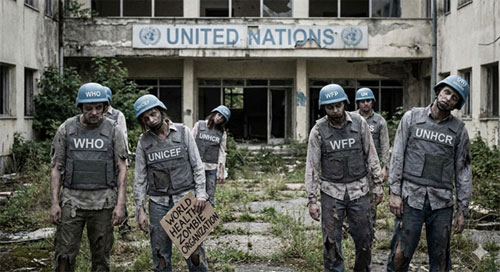
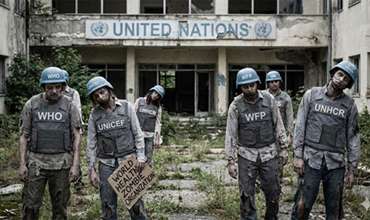
AI generated photograph
In a dramatic turn of events that could only be missed by those truly living under a rock, the eruption of a metaphorical "Supernova" in early January 2026 has signified the collapse of the world law and economic order as we know it. This seismic shift, originating from a series of aggressive unilateral actions by the United States, has sent shockwaves through the international agencies tasked with enforcing rules-based law and order.
Today, the international agencies responsible for enforcing rules-based law and order, such as those in the fields of economics, finance, international trade, health, sovereignty rights, and the environment, have transformed into ‘Zombie Agencies’, possessing no power against a rampant superpower determined to uphold its ‘might is right’ philosophy. Every day, more and more knives are driven into these United Nations (UN) and non-UN Agencies, but like the Zombies in the ‘Friday the 13th’ movies, you cannot kill them because they are already dead!
The First Stab: Economic Warfare
The unravelling began on April 2, 2025, when then-President Donald Trump announced his "Liberation Day" tariffs. These tariffs were met with a robust response from China, who imposed their own retaliatory measures, effectively delaying the demise of international trade agencies. Yet, this was merely the opening salvo in a series of events that would further destabilize the global order.
The Second Stab: Military Aggression and International Law
A more profound blow to the rules-based system came in June 2025 when the U.S. unilaterally conducted airstrikes on Iranian nuclear facilities. The operation, known as "Operation Midnight Hammer," saw the deployment of GBU-57 Massive Ordnance Penetrators, marking a blatant disregard for International Humanitarian Law (IHL) and the Geneva Conventions.
The international community watched as the UN's authority was further eroded, with Secretary-General António Guterres expressing grave alarm at this escalation. Yet, despite the outcry, the strikes continued unimpeded.
The Fatal Blows: The Venezuelan Crisis: A Point of No Return
The disintegration of international norms reached a tipping point on December 10, 2025, with the U.S. seizure of the Venezuelan-linked oil tanker, ‘Skipper.’ Framed as an enforcement of sanctions, the action was condemned by Venezuela as an act of international piracy.
However, the decisive and fatal blow came on January 3, 2026, when the U.S. conducted military strikes in Venezuela and kidnapped President Nicolás Maduro and his wife. Codenamed 'Operation Absolute Resolve. This action flagrantly violated Article 2(4) of the UN Charter, which prohibits the use of force against the territorial integrity or political independence of any state. The operation, lacking UN Security Council authorization, self-defence justification, or consent from Venezuela, highlighted the erosion of the rules-based international order.
Commentators and legal experts quickly condemned the U.S. actions as unlawful. The absence of a legal framework to justify this intervention underscored a growing trend of unilateralism, where might supersedes right. International law purists argue that breaches are inherent in any legal system, yet the scale and brazenness of these actions suggest a fundamental shift away from established norms.
The New World Disorder: Shifting Power Dynamics
The consequences of these events are profound, signalling a new era of global politics characterized by great power competition and a departure from multilateral cooperation. The U.S., under President Trump, has embraced a strategy that prioritizes national interests over international norms, fundamentally altering geopolitical alignments.
China and Russia, often labelled as 'rogue states' by Western media, have largely adhered to international law, though the U.S.'s recent actions may embolden them to assert their influence more aggressively. President Trump's open ambition to profit from Venezuelan oil and his demand for control over Greenland exemplify this new ethos of power politics.
American allies, such as Australia, find themselves in a precarious position, forced to navigate a world where traditional alliances are tested by unpredictable U.S. policies. The Trump administration's willingness to deploy hard power, rather than relying solely on diplomatic or economic measures, has unsettled old alliances and fueled concerns over potential military actions against even NATO members.
A Fractured Global Order: The Fallout of U.S. Unilateralism
The U.S.'s recent actions have accelerated the decline of the international rules-based order, effectively transforming global governance institutions into powerless entities—Zombie Agencies. On January 9, 2026, President Trump withdrew the U.S. from 66 international organizations deemed "wasteful, ineffective, or harmful." This included 31 UN bodies and 35 non-UN organizations, with the administration arguing that these entities promoted agendas contrary to U.S. interests.
Among the targeted organizations were key programs focused on climate change, population, health, women's rights, and sustainable resource management. Notable examples include the United Nations Framework Convention on Climate Change (UNFCCC), the UN Population Fund (UNFPA), and UN Women. The withdrawal of the U.S. from these programs marks a significant retreat from multilateral commitments that have underpinned global cooperation for decades.
The U.S. administration justified these withdrawals as a necessary refocusing of resources on "America First" priorities. Secretary of State Marco Rubio remarked that these organizations were often dominated by progressive ideologies detached from U.S. national interests. This perspective reflects a broader shift towards unilateralism, where the U.S. prioritizes its sovereignty and economic strength over collective global governance.
Navigating the New World Disorder
The current trajectory suggests a world moving towards competing spheres of influence, with major powers like the U.S., China, Russia, and India asserting their dominance in regional and global affairs. The abandonment of rules-based order by the U.S. has accelerated China's resolve to emerge as a superpower rivalling America. The Chinese economy continues to grow, with Beijing investing heavily in its defence forces and positioning itself as a key player in Asia and beyond.
This shift in power dynamics poses challenges for traditional U.S. allies, who must reconsider their strategic alignments in an increasingly unpredictable geopolitical landscape. The potential for a new Cold War looms, with nations aligning themselves within competing blocs defined by economic, military, and ideological interests.
Consequently, nations across Asia may need to rethink the wisdom of being aligned with Washington, DC, when the leader in the White House is such an unreliable ally. Europe may need to consider the unthinkable: inviting Russia to join NATO. After all, as spoken by Michael Corleone in the Godfather Part II movie, “Keep your friends close, but your enemies closer.
Professor Janek Ratnatunga, MBA, PhD (Bradford, UK) is a former Associate Dean of Business & Economics at Monash University and is currently CEO of the Institute of Certified Management Accountants of Australia & New Zealand (CMA ANZ).


Meteorology Department forecasted that showers will occur at times in Northern, North-central, Eastern and Northwestern provinces and in Matale and Nuwara-Eliya districts.


Former President’s Secretary Saman Ekanayake was today remanded until February 11 by the Fort Magistrate in relation to the case where former President Ranil Wickremesinghe is alleged to have misused Rs. 16.6 million in state funds during a visit to the UK to attend his wife’s graduation ceremony at the University of Wolverhampton.






Leave Comments